

Josh Kirk, Evgenia Passari, Washington Ochieng, Panagiotis Angeloudis
Increasing geopolitical tensions
Increasing geopolitical tensions
Vulnerabilities of globalisation
Increasing geopolitical tensions
Vulnerabilities of globalisation
Need to transition to sustainable energy sources
Increasing geopolitical tensions
Vulnerabilities of globalisation
Need to transition to sustainable energy sources

Increasing geopolitical tensions
Vulnerabilities of globalisation
Need to transition to sustainable energy sources
Requires a new system of trade
$325bn of trade in 2022
$325bn of trade in 2022
Charter rates $100k-300k per day
$325bn of trade in 2022
Charter rates $100k-300k per day
Disruptions increase costs and reduce transport capacity
Combined multiple sources of public data
Combined multiple sources of public data
Created a network of global Natural Gas trade
Combined multiple sources of public data
Created a network of global Natural Gas trade
Combined multiple sources of public data
Created a network of global Natural Gas trade
Formulated a Non-Linear Program
Includes both trade networks
Formulated a Non-Linear Program
Includes both trade networks
Linearised to a bilinear Mixed Integer Program
Using big-M constraints
$$ \begin{equation} \begin{aligned} & \text{minimise} & \text{Supply deficit} \\ & \text{subject to} & \text{Conservation of mass} \\ \end{aligned} \end{equation} $$
$$ \begin{equation} \begin{aligned} & \text{minimise} & \text{Supply deficit} \\ & \text{subject to} & \text{Conservation of mass} \\ & & \text{Use of storage} \\ \end{aligned} \end{equation} $$
$$ \begin{equation} \begin{aligned} & \text{minimise} & \text{Supply deficit} \\ & \text{subject to} & \text{Conservation of mass} \\ & & \text{Use of storage} \\ & & \text{Link flow capacities} \\ \end{aligned} \end{equation} $$
Solves a problem over
Solves a problem over
48 months
Solves a problem over
48 months
126 countries
Solves a problem over
48 months
126 countries
1660 trade links
Solves a problem over
48 months
126 countries
1660 trade links
to global optimality in
to global optimality in
vs 12.9s for the Non-Linear Program
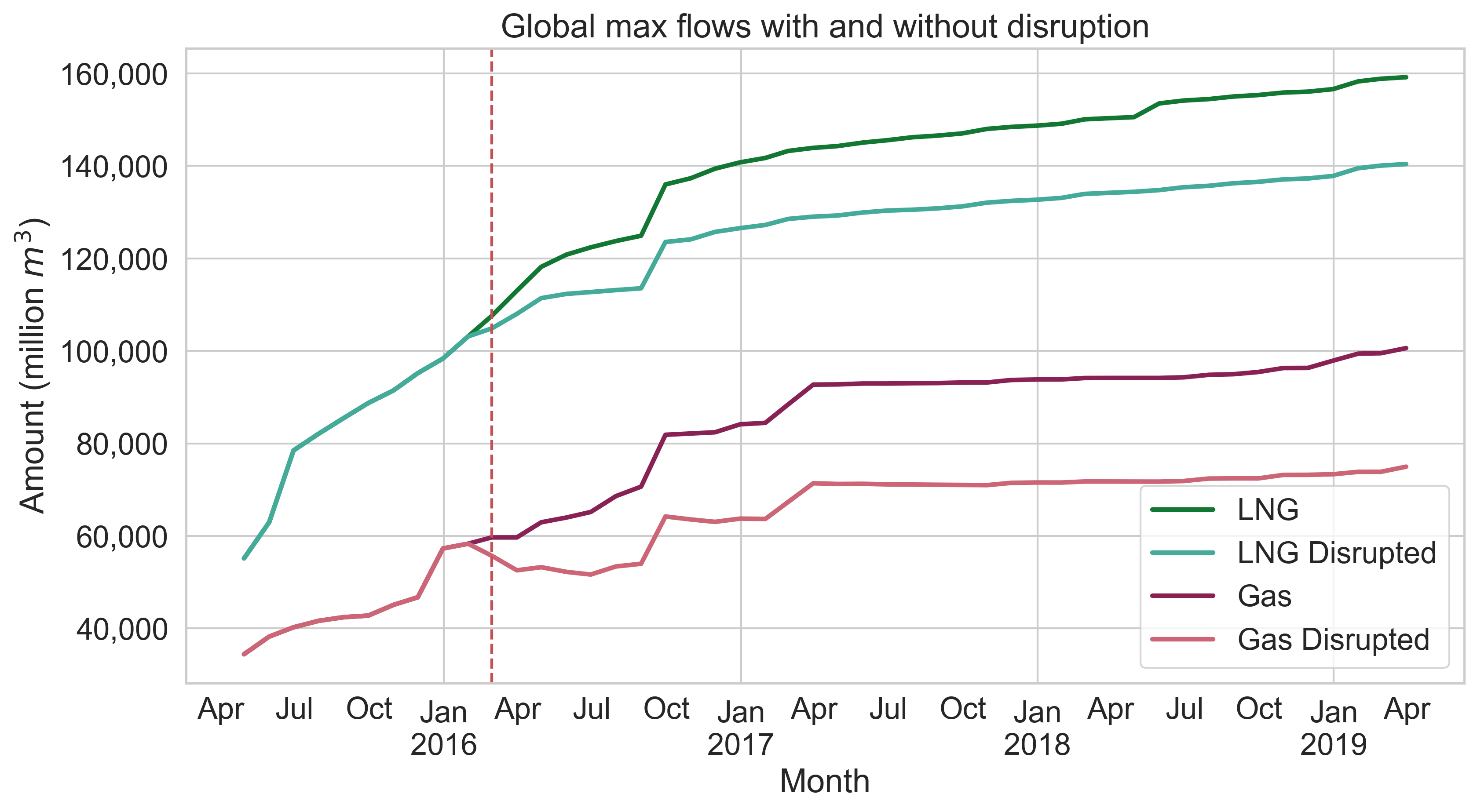
Pipeline worse affected
Pipeline worse affected
Little Russian export capacity by Jan 2017
After disruption
of flows changed
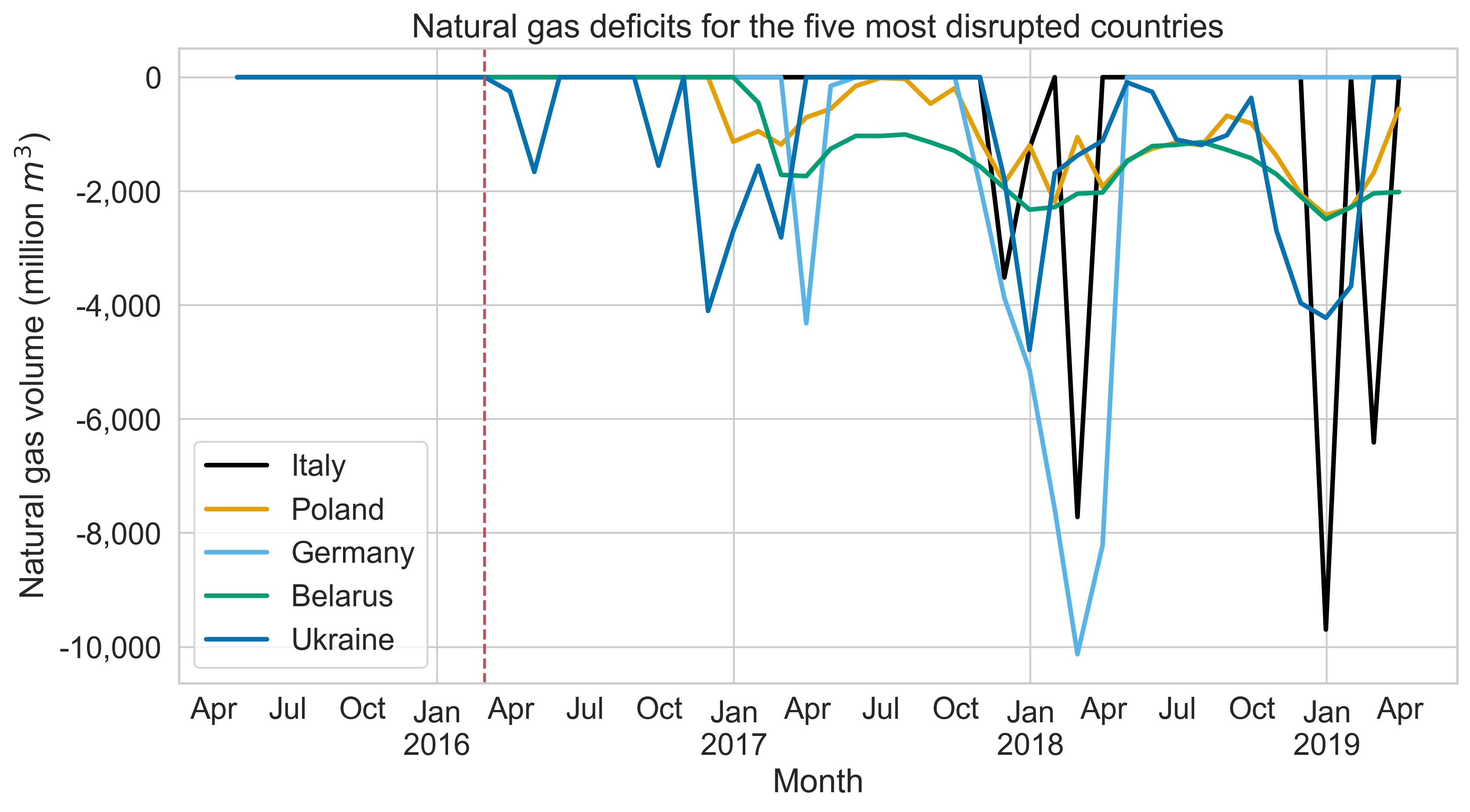
No deficit before disruption
No deficit before disruption
Large pipeline importers worst affected
Evaluating various scenarios
Of interest to
Include shipping (AIS) data
Include shipping (AIS) data
Include shipping (AIS) data
Include shipping (AIS) data
Apply methods to other commodities
Include shipping (AIS) data
Apply methods to other commodities
Include shipping (AIS) data
Apply methods to other commodities